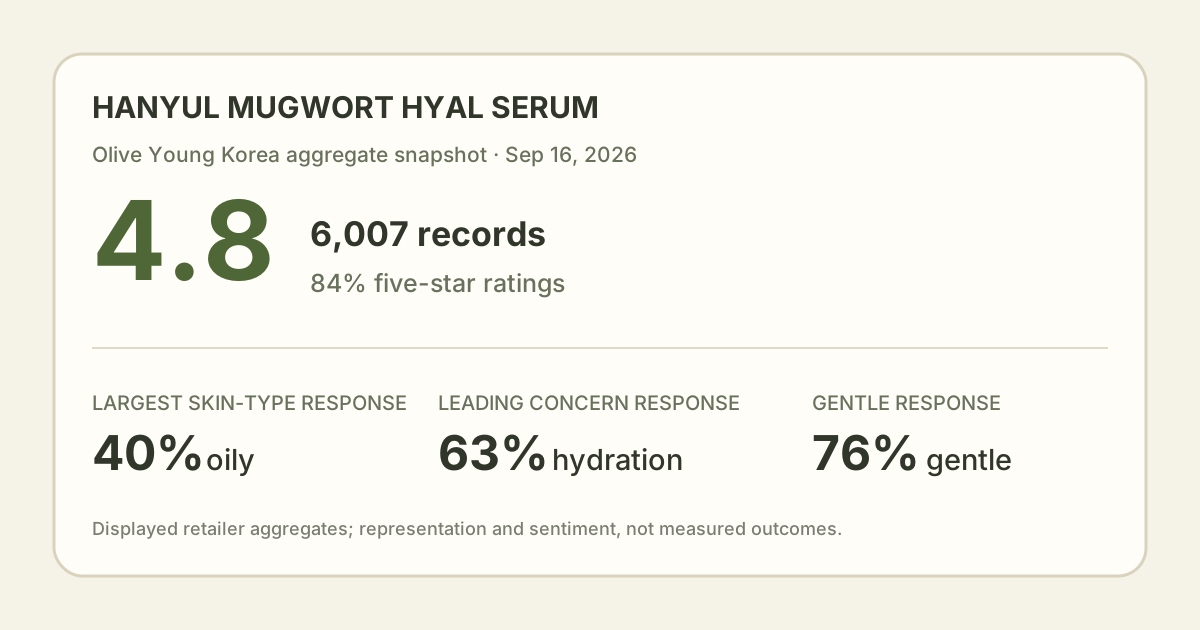
Aggregate data captured September 16, 2026. This article uses only the product title, offer, rating, rating distribution, and survey shares displayed on a Korean K-beauty retail platform. It does not reproduce or translate an individual review, reviewer name, or user photo.
The short version: the listing averaged 4.8 stars across 6,007 review records. Five-star ratings accounted for 84% of the displayed distribution. Oily skin was the largest skin-type response at 40%, hydration was the leading concern response at 63%, and 76% selected the gentle response.
The average displayed rating was 4.8 out of 5. The detailed distribution showed 84% five-star, 11% four-star, 4% three-star, 1% two-star, and 0% one-star. Those displayed shares total 100%, but they remain rounded presentation values. They should not be converted into exact record counts because the source did not expose the underlying count for every star bucket.
The high-rating concentration describes storefront sentiment at one point in time. A base above six thousand records is less sensitive to one unusual score than a very small sample. It still is not a controlled study, an independently verified unique-buyer count, a repurchase rate, or a forecast for a new buyer. The page also noted that linked reviews may cover materially identical configurations with different volumes, bundles, or packaging.
The captured skin-type poll displayed 40% oily, 39% combination, and 20% dry. Oily and combination respondents were almost evenly represented, while dry respondents formed a smaller group. The rounded values total 99%, showing why the display should be read as approximate shares rather than exact participant counts.
Representation is not suitability. The 40% figure does not mean the serum succeeds for 40% of oily-skin users, and the 39% figure is not a compatibility rate for combination skin. The page did not display a separate denominator for this poll. Climate, routine, application amount, concurrent products, sensitivities, and the reason each respondent selected a label were not controlled.
The separate concern poll showed 63% hydration, 36% soothing, and 1% wrinkle or brightening. These displayed shares total 100%. Hydration clearly led the available categories, which says what concern was most represented in this feedback pool. It does not show that 63% measured a change in skin hydration or that the serum caused one.
The 36% soothing response likewise is not evidence that the formula treats irritation, redness, acne, eczema, or another condition. The 1% wrinkle or brightening response is not a clinical finding in either direction. No instrument reading, standardized before-and-after image, control group, treatment protocol, or independent clinical assessment was part of the retailer aggregate captured for this article.
The irritation poll displayed 76% gentle, 23% ordinary, and 0% felt irritation. Rounded shares total 99%. Gentle was the leading response, but zero on a rounded retailer display does not prove that no one experienced irritation. It is not an adverse-event rate, allergy test, dermatologist assessment, or safety certificate.
The separate poll denominator was not displayed. Individual tolerance can differ with ingredient sensitivities, barrier condition, amount, frequency, other actives, and the regional formula. If a known allergy, diagnosed condition, prescription routine, pregnancy question, or prior serious reaction is relevant, the current ingredient list and qualified guidance matter more than the majority label.
Only a category-level description is responsible here. A serum is generally a leave-on liquid or gel-like step intended to spread in a thin layer, but that broad format says nothing reliable about this product's exact viscosity, slip, tack, richness, scent, absorption speed, residue, pilling, or makeup compatibility. I did not open, apply, smell, spread, or wear it.
The local visual is deliberately brand-neutral and code-drawn. It illustrates a generic translucent serum format without copying the retailer's packaging, product photographs, or shopper images. The English working name “Mugwort Hyal Serum” helps identify the Korean listing, but the name alone does not establish the amount of mugwort-derived material, hyaluronic acid, or any other ingredient. Concentrations and claims should come from the current regional label.
At capture, the Korean listing displayed a ₩35,000 reference price and a ₩23,800 promotional price. The title described a 40 ml serum with a 40 ml refill and a randomly selected Sanrio Hello Kitty mirror. This is a bundle price, so comparing it with a standalone bottle requires checking the usable amount and whether the refill format suits you.
Promotions, gifts, stock, taxes, shipping, seller, and regional configuration can change. The captured amount is a dated Korean-market reference, not a current quote or a savings guarantee. A character mirror has no review-data value and should not outweigh formula fit. Compare the final checkout total, total serum volume, refill compatibility, current shelf-life information, and return terms for the exact listing you would buy.
This capture did not preserve a complete current ingredient list or verified directions. It therefore does not support an estimate of mugwort-derived ingredient content, hyaluronic acid content, fragrance status, alcohol status, active concentration, comedogenicity, pregnancy suitability, or regional formula equivalence. The rating and polls cannot fill those gaps.
Oily skin was the largest displayed response at 40%, with combination skin close behind at 39%. That makes both groups well represented in the poll, but it does not prove the serum performs better for either one.
No. Hydration was the concern label selected most often. It was not an objective measurement of moisture level, duration, or a change caused by the product.
The gentle response led at 76%, while the displayed felt-irritation share rounded to 0%. This is a broad perception signal, not a guarantee of tolerance or a substitute for the current ingredient list and individualized advice.
The listing category identifies it as a serum, but this analysis did not test the actual texture. The generic illustration is not evidence of viscosity or finish. Check the current official description and, when possible, a tester or return policy.
The captured discount may be attractive if you want the full 80 ml serum volume and can use the refill. Compare the final price, refill handling, shelf-life information, and regional seller. Assign value to the mirror only if you would have wanted it separately.
Hanyul Mugwort Hyal Serum had a strong captured storefront profile: 4.8 stars from 6,007 linked review records, with 84% of the displayed distribution at five stars. Oily and combination respondents dominated the skin-type poll, hydration led the concern poll, and gentle was the leading irritation response.
That is enough to make the serum a reasonable comparison candidate, not enough to promise hydration, soothing, compatibility, or individual tolerance. Use the aggregate alongside the current ingredient list, verified directions, exact regional pack, final price, and your own constraints.
Source: Olive Young Korea product page, captured September 16, 2026. Product title, price, pack, rating, rating distribution, and poll values can change.
← Back to all analyses · Review-volume ranking · Skin-type poll view